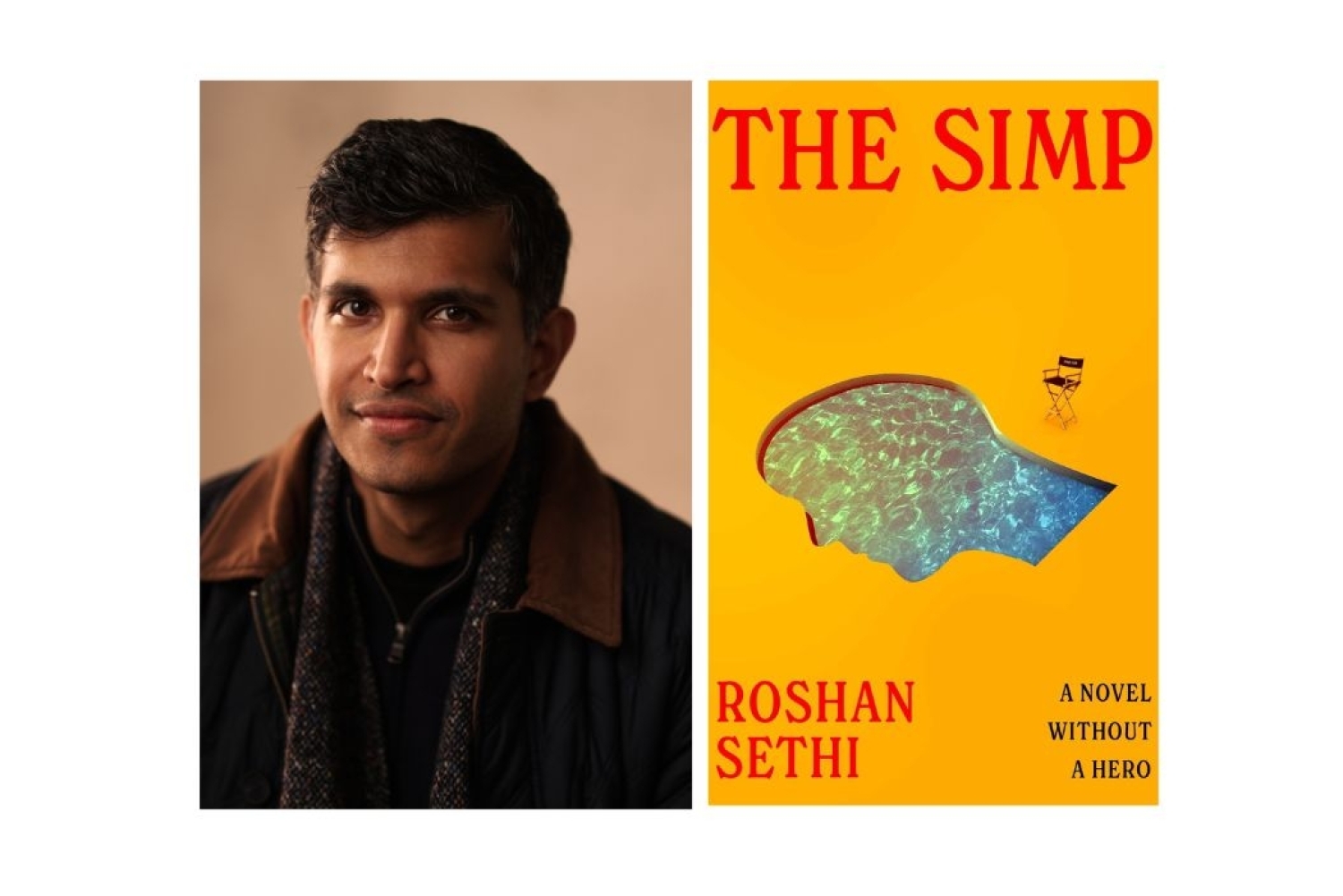
When Roshan Sethi began writing his debut novel, The Simp, it was not a calculated pivot from screen to page. He had been working in Hollywood since 2014, building a career first as a medical consultant, then as a writer and eventually as a director. Books, however, had always been closer to him than film. ‘I’ve been mainly a reader more than I’ve been a watcher, actually, since I was a kid, I read about a book a week.’
The novel arrived after years of wanting to write one and not having the right story. The spark came unexpectedly from the 19th century. Roshan was reading Vanity Fair by William Makepeace Thackeray, drawn to its antihero, Becky Sharp, a con woman and nakedly ambitious social climber. ‘I wanted to tell a similar story but in Hollywood.’ What emerged was an update set in the contemporary entertainment industry, shaped by his own complicated relationship with it.
Nothing in the book is directly lifted from his life but its emotional undercurrents are deeply personal. ‘I love Hollywood in some ways, and I despise it in other ways’, he describes it as a ‘vastly exclusionary industry’ that often gatekeeps people with real talent. The novel channels not specific incidents but the ‘emotional valences’ of his experiences. Much of it was written from a place of frustration.
At the centre of the book is Raj, an Indian American striver, whose ambition is matched only by his delusion. For Roshan, that combination is not accidental. ‘I think you need delusion to be successful, creative. And there’s no way around it’. Belief in oneself must, at times, exceed reason. In an industry he calls impenetrable and chaotic, delusion becomes a survival tool. ‘It requires a lot of confidence to have the patience or the fortitude to wear it out, to wear down the walls that surround it.’
Hollywood, in his view, produces particularly unsavoury types because of how unfair it is. He contrasts it with medicine, another world he inhabits. In America, anyone can apply to medical school. There is at least a defined entry point. Hollywood, he argues, offers no such clarity. ‘People ask me all the time; how do you get in? And I find myself bewildered in giving advice because it seems completely chaotic and random.’
Roshan’s own path into the industry was circuitous. While still in medical school, he became a consultant on the television show Black Box. From there, he slowly worked his way in, taking on writing and directing roles. ‘In a weird way, I would never have been a writer or a director if I was not a doctor.’ His medical expertise gave him value in a system that might otherwise have overlooked him. ‘If I had just been a random Indian knocking on the door of Hollywood, I don’t know if I would have entered, despite my talent.’
His disdain for contemporary portrayals of Hollywood is blunt. He says he does not read contemporary fiction and finds many films and shows about the industry oblivious. Instead, his literary loyalties lie firmly in the 19th century. He prefers fiction that is driven by narrative. Modern novels, he argues, have drifted from story toward atmosphere. ‘Now what I feel has happened to a lot of contemporary fiction is it’s been replaced by vibes. And I need a story.’
That commitment to storytelling shapes his writing process. He wrote The Simp in Los Angeles after several of his films had fallen apart. ‘I was full of bitterness and rage’. For four weeks, he wrote two thousand words a day, three hours each morning, finishing a draft in a month. Roshan writes by instinct rather than outline. He begins each day without knowing what will happen next. ‘Now what?’ he asks himself each morning. He compares the process to improv, where the pressure to generate produces surprising ideas. Planning too much, he believes, turns writing into math. ‘Then it stops being surprising and driven by whatever is happening.’
The subtitle of Thackeray’s novel, ‘a novel without a hero,’ reappears in this book. Raj, like Becky Sharp, is not admirable in a conventional sense. He is delusional and often unsavoury, yet recognisable. The title itself gestures toward a kind of obsequiousness. To be a simp, he notes, is to be ingratiating toward power. It is a posture he feels he has adopted in Hollywood, though one now curdling into disdain. If there is one thing he wants readers to take away, it is the scale of the industry’s inequity. He believes Hollywood prefers playful self critique to genuine reckoning. As someone who also belongs to medicine, he feels he can see the contrast clearly. The system, he insists, is structured in a profoundly unfair way.
As for what comes next, there is no immediate second novel. He recently finished filming an independent action movie with Michelle Yeoh, which will head to festivals before a release. For now, The Simp stands as both indictment and catharsis, a story born from frustration and shaped by a writer who trusts instinct over blueprint. In many ways, the novel reads like a confrontation, not simply with an industry, but also with the unspoken compromises, humiliations and fragile hopes that often shape the pursuit of creative success.
This is an article from the May 2026 Bookazine. For more such stories, purchase a copy here.
Words Neeraja Srinivasan
Date 1.8.2026