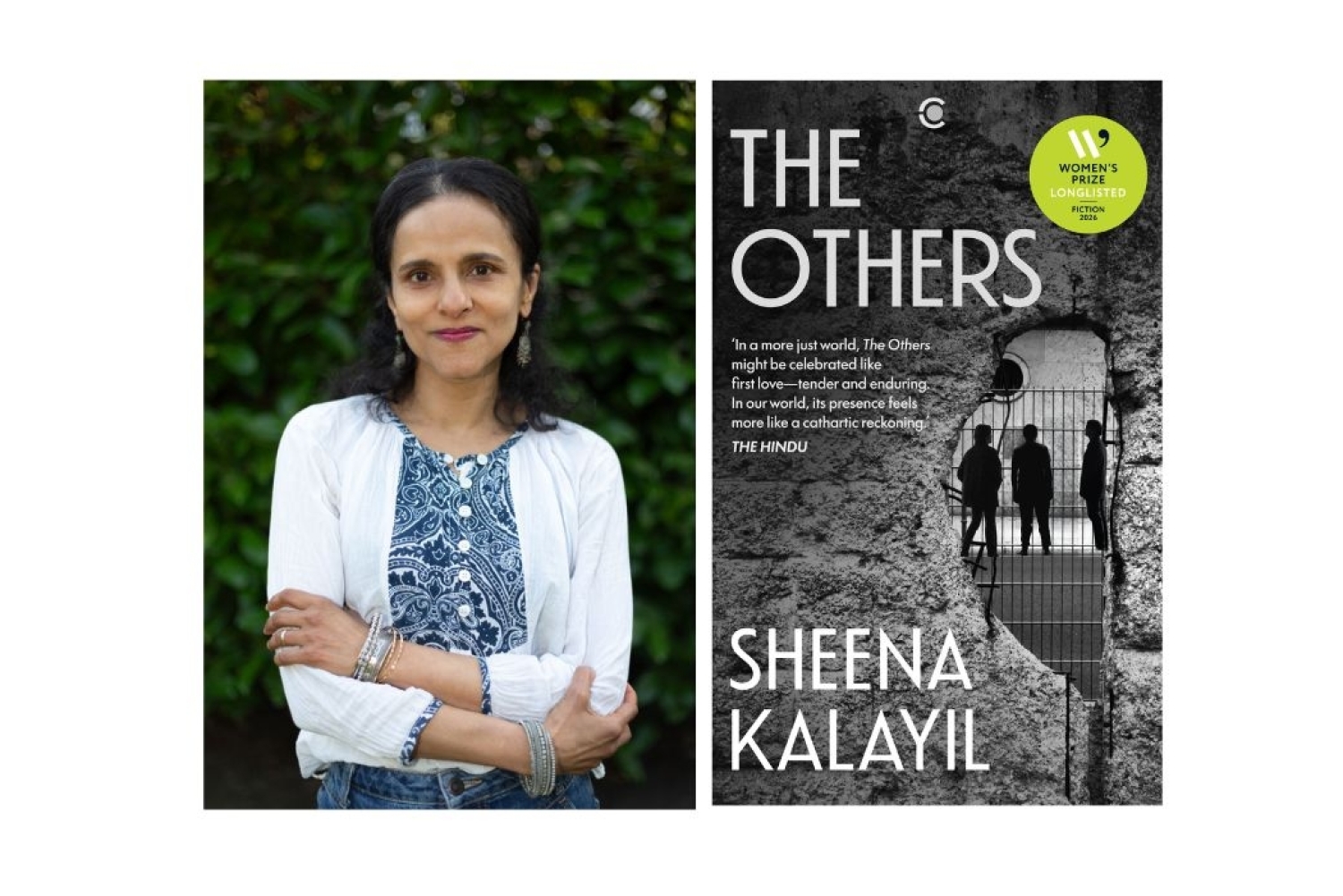
For writer Sheena Kalayil, migration is central to her story. Her parents left Kerala in the 1960s to teach in newly independent countries in Africa, while she herself became a ‘serial migrant’ as a young adult, living and working across different countries before eventually settling in the UK. It is this experience of displacement and chance that informs her latest novel, The Others.
Set against the fall of the Berlin Wall, the novel follows three young people from vastly different backgrounds: Lolita, an Indian woman; Armando, a Mozambican man; and Theo, an East German. She wanted to challenge the Western perspective of the period and explore its upheaval through a global lens. ‘Why can an Indian author not write about the fall of the Berlin Wall?’ she asks, pushing back against a literary industry that expects writers to ‘stay in your lane’.
At its heart, The Others examines how chance, choice and circumstances interact in the way our lives evolve, while asking what it means to find home when you have spent a lifetime on its fringes.
Migration is central to this story. What keeps drawing you back to this theme, and what new question were you asking with The Others?
My own life reflects the vast diversity of experience which we call ‘migration’. My parents left Kerala in the 1960s to take up teaching jobs in newly-independent countries in Africa. My father went on his own to Tanzania, and then after they married, took my mother with him to Zambia. They taught in Catholic schools, which played a central part in educating a new middle class of local children. Hence, my parents were integral to developing the opportunities for people who had previously been excluded by colonial regimes. But with these teaching posts, my parents were also being offered opportunities which they may not have had if they remained in India. The schools, their students, were therefore equally integral to the development of my parents. Migration can be, often is, mutually beneficial, between host and migrant. And then I became a migrant, even a serial migrant as a young adult, living and working in different countries where, with my Indian passport, my papers could be arranged. I suppose these experiences of migration, of being a member of a diaspora, cut deep.
I'm continually drawn to characters who share the trials and benefits of displacement. And yet I have ended up settling in the UK, not through deliberate efforts, but because by chance I fell in love with an Englishman. That's a pretty big stroke of luck! There were so many other ways my life could have played out, with different decisions, circumstances and uncontrollable forces. In The Others I was trying to show how chance, choice and circumstances interact in the way our lives evolve.
How did you build the friendship between Armando, Theo and Lolita? Why was it important that they came from vastly different backgrounds?
Eastern Bloc countries offered scholarships and work to young people from what we now call the Global South. But they are rarely portrayed in creative works as being ‘multicultural’ or ‘diverse’ societies. I was an engineering student on a placement in Budapest in 1989, and later I worked in Mozambique and met the Madgermanes, the Mozambicans who lived and worked in the DDR and who left after German reunification. And so I had first-hand experience of life behind the Iron Curtain, and that multicultural aspect. And so, the three protagonists reflect that diversity, with Lolita being Indian, Armando being Mozambican and Theo being East German. Their friendship grew from their characters; I knew Armando would meet someone like Lolita, who would place him in a dilemma relating to his relationship with his young daughter. I drew on the universal angst and fears and excitement of being in your 20s, to place the characters in scenarios which they had to navigate. From there, their relationships grew and developed into a narrative.
“In The Others, I was trying to show how chance, choice and circumstances interact in the way our lives evolve. ”
What prompted you to set the story within the backdrop of the fall of the Berlin Wall?
I wanted to challenge the Western perspective of that event, and the ensuing collapse of the Soviet Union, the end of the Cold War. I wanted to explore the story through a global lens, to show how it impacted people from all over the world. It is a period of history which is fascinating, heralding a new world order. But, it also coincides with when I was the age of my protagonists, or at least close in age. I was nineteen in 1989. So, above all, I wanted to explore the personal dilemma that, as young adults, my characters would face, juxtaposing these with momentous political changes not of their making.
I was also challenging a prevailing discourse in the UK literacy industry which expects you to stay in your lane…why can an Indian author not write about the fall of the Berlin Wall?
You write about belonging with remarkable nuance. Has your own understanding of 'home' changed over the years?
I'm definitely able to answer the question ‘where is home?’ more proficiently now! ‘Home’ has many meanings and these can change depending on context. I have stopped worrying about where I belong, where I fit in, whether I'm enough of this or that. Basically, I'll always be an outsider and on the fringes and that's where I am happy to be! I feel at home with myself and who I have become and what I have achieved. I feel at home with my husband and children, no matter where we are. It could be walking on Lighthouse Beach in Kovalam in the evening, or hiking through the woods in the countryside near Manchester. When you have an adverse childhood, you become hyper-independent, but also hyper-aware of and hyper-sensitive to people's behaviour and tensions in the atmosphere. I hope I bring some of that to my writing.
What does a regular day of writing in your life look like?
Irregular, because I don't have the privilege of regular writing days. But I see this as a good problem to have. I have a good job as a university lecturer, I love teaching and working with students. I have a lovely family. I have Fridays off, and if nothing else crowds in, it's the closest I have to a writing day. It means that I spend a lot of time thinking and mulling over my writing, jotting notes, sentences, paragraphs in a notebook. When I get a chance to write at a stretch, I'm desperate to get things down. I usually write a character first and the plot develops from that starting point.
What are you working on currently and what’s next?
I have just co-written my first play with colleague Dr Andy Smith, called The Antiracist University. It aims to be part of a toolkit for antiracist work in higher education in the UK. We've had several stagings and are now working on an essay about writing the play. I'm also waiting for my agent to give me her thoughts on a near first draft, as well as thinking and mulling over another idea.
Words Neeraja Srinivasan
Date 11.8.2026